
Byron Township City Directory Shelves
Byron Township is a civil township rather than an incorporated city, so a useful city directory search often starts under Byron Center, Kent County, or a broader Grand Rapids-area title. The historical shelf is spread among local, regional, and state collections. Polk surname volumes, Bresser reverse books, newspapers, maps, and museum material each answer a different question. The sources below are the confirmed routes, with their limits kept visible.
| Collection | Years | Where Held | Access |
|---|---|---|---|
| Byron KDL local history | Current collection, no complete directory run published | Byron KDL | Branch staff, computers, and local-history material |
| Polk city and county directories | Late 1800s onward; exact Byron run unverified | Library of Michigan, GRPL, and library catalogs | Print, microfilm, fiche, or licensed online resources |
| Bresser reverse or criss-cross books | Especially late 1960s; exact Kent run not located | Library of Michigan and area libraries | Address-first household clues where a volume exists |
| Kent County-West Polk catalog record | Exact year not displayed | Grand Rapids Public Library | In-library use, with Byron Center listed as a subject |
| Google Books Grand Rapids directory scans | Related full-view editions include 1859, 1886, 1911, and 1924 | Google Books | Check each title page and page image for local coverage |
Neither the public KDL page nor the captured GRPL catalog gives a complete, year-by-year Byron Center directory run. A Grand Rapids title does not prove that an address in Byron Township appears in it. Ask staff to check the individual volume and catalog record, then save the publication year and page number with the transcription. Those small details make it possible to revisit a listing later.
Note: A missing year in a catalog or scan is a collection gap, not proof that a household was absent from Byron Township.
Why Byron Township Directories Have Broader Titles
Names on older records do not always match a present map label. A directory may file a household under Byron Center, Kent County, a rural route, or a Grand Rapids-area heading. Deeds use a legal description, while a parcel result uses the governmental unit and a postal address may use a different locality. Keep the exact printed place name in research notes and search the alternate forms: Byron Township, Byron Center, North Byron, Cutlerville, and the relevant county title.
The Library of Michigan city-directory guide identifies publishers including R.L. Polk, Robinson's, Norton, Johnson, W.C. Bailey, and Luedder. Polk runs began in the late nineteenth century, while Bresser material is particularly useful for later address work. The guide places print city and county directories, along with microfilm, on the Library of Michigan's second-floor south area and recommends an ANSWER catalog search using a city name plus “city directory.”
A street address can be an important cross-check, but the modern address record belongs to the Byron Township street directory work. Historical volumes are strongest when they establish a dated household clue, then the parcel and deed trail tests whether the place is the same one.
Byron Township City Directory Work at KDL
Byron KDL is the practical local starting point for a Byron Township city directory search. The branch at 8191 Byron Center Ave SW offers public computers, Wi-Fi, free printing, staff access to local-history and genealogy material, and research databases. Published hours are Monday through Wednesday 9:30 a.m. to 8 p.m., Thursday noon to 8 p.m., Friday and Saturday 9:30 a.m. to 5 p.m., and closed Sunday. Calling ahead helps when a search depends on a physical volume or staff assistance.
The branch's own history fits the collection story. Township Clerk book lending began locally in 1887, and the present 13,640-square-foot branch opened in 2003. KDL's genealogy resources point to census, vital, immigration, court, directory, photograph, obituary, and map material. A newspaper notice or obituary can supply a date, family relationship, road, or organization, but county records should verify the resulting land or probate lead.
See the Byron KDL branch and local-history resources before planning a visit.
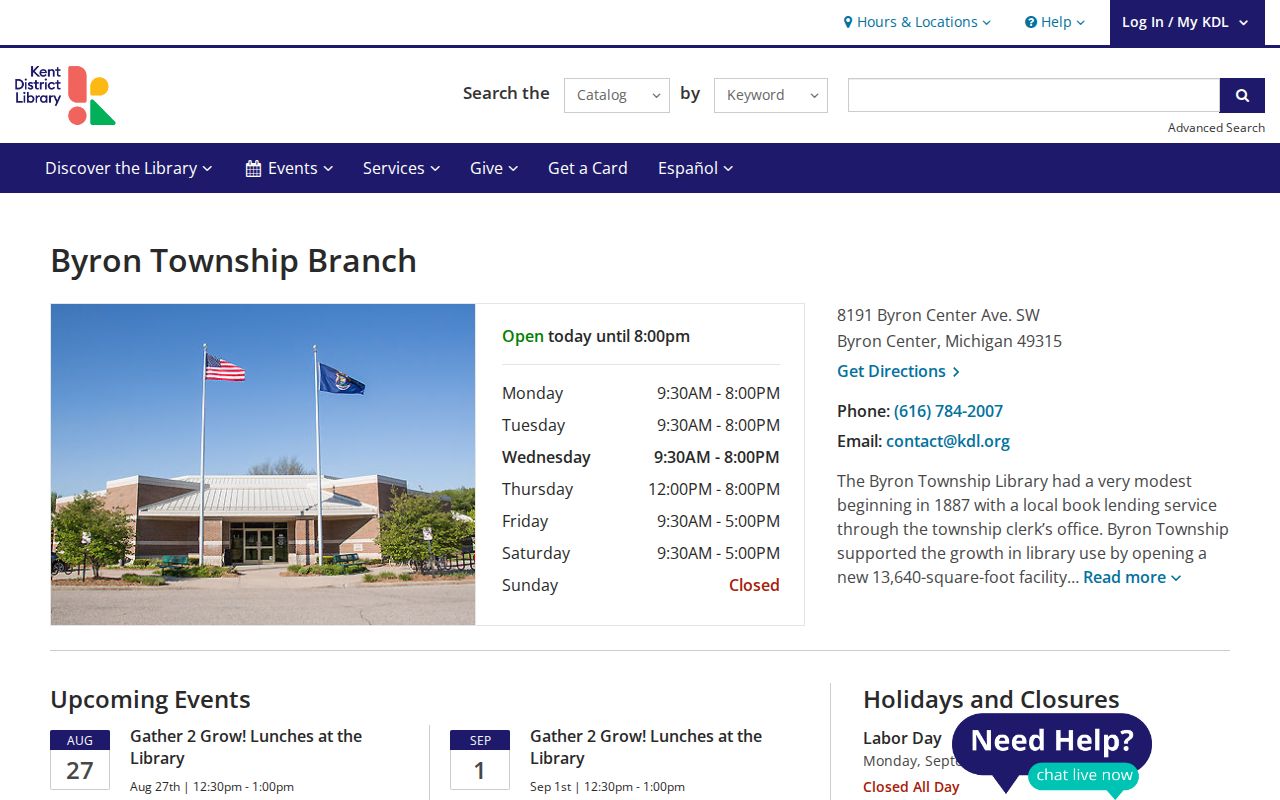
The branch screen reinforces the local route to staff help and genealogy material, rather than promising a complete online directory run.
Byron Township City Directory Scans and Guides
The Google Books Grand Rapids City Directories collection offers a digitized 1911 item and metadata for related full-view editions. Use the title page and the actual page image to confirm the geography. The captured metadata can be confusing, and optical character recognition often breaks short directory abbreviations. A Google scan is a lead to inspect, not evidence that every Byron Center address was printed.
Inspect the digitized Grand Rapids directory collection as a visual source before relying on OCR.
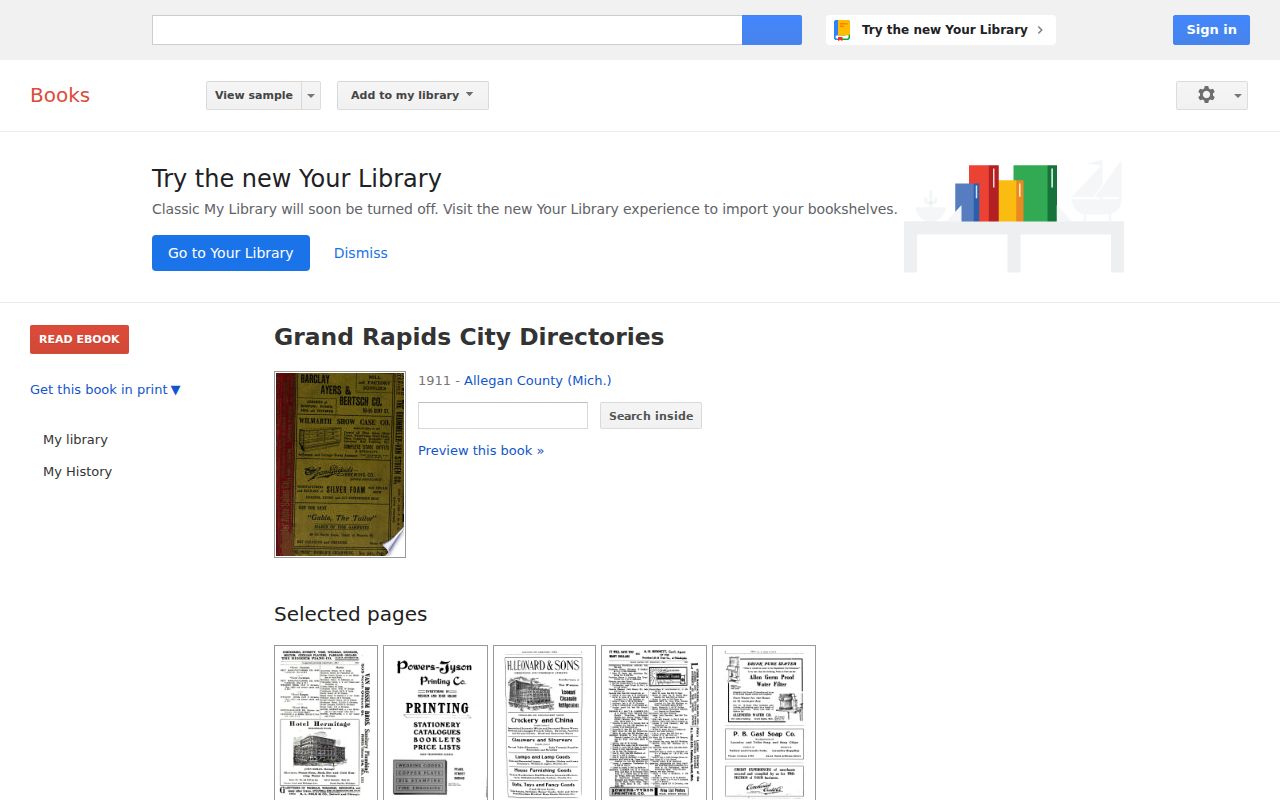
Directory images preserve the layout, headings, and abbreviation keys that OCR can lose, which is important when a surname or address is uncertain.
The Library of Michigan directory guide supplies the wider map of print, microfilm, fiche, and online options, including licensed resources such as Ancestry Library and HeritageQuest. Gazetteers are intermittent from the mid-1860s through 1931/32. Use the guide to locate a likely series, then verify the volume and its geographic reach at the holding library.
Consult the Michigan city-directory and gazetteer guide for the collection conventions behind the shelves.
Its guidance helps distinguish a surname directory from a reverse directory and prevents a broad regional title from being mistaken for a township-wide roll.
Reading a Byron Township City Directory Entry
A city directory entry is a dated published listing, not a full household record. The 1911 directory conventions documented in the research can show a surname and given name, spouse or widow notation where supplied, an occupation abbreviation, a street address, locality, and cross-reference material. Print the entry exactly before expanding an abbreviation. Terms such as wid, tchr, and carp appear in OCR, but the volume's key and page image control their meaning.
| Name line | Surname and given name, with spouse or widow notation only when printed. |
|---|---|
| Address | The publication's house number, street, and locality, which may use a postal or broader-area label. |
| Work notation | A printed occupation abbreviation when the entry includes one; use the volume's key before transcribing it. |
| Street order | Polk-style street sections are generally alphabetical by street and then by house number. |
| Ownership mark | Some runs show an owner or renter indicator, but it remains a publication-year clue rather than proof of occupancy. |
- Criss-cross directory
- An address-first directory arranged by street and house order, commonly listing a head of household and sometimes a telephone or status clue.
- Householder index
- A section that points from a household name to an address. It may omit people who were not listed as the household head.
- Abbreviation key
- The printed explanation of short forms, usually near the front of a volume. Photograph it before interpreting an uncertain entry.
Trace Families in Byron Township City Directories
Follow a household through adjacent directory years, but keep separate columns for an owner, an occupant, a mail recipient, and a household member. A deed can show a recorded interest, while a directory often provides an address or head-of-household clue between deeds. The federal census adds relationships and ages for public years, but it is not a record of uninterrupted residence. In 2026, 1950 is the latest generally public census year under the federal 72-year release rule.
- Begin with the known address or surname and record the locality exactly as the volume prints it.
- Copy the year, page, name form, address, spouse or widow notation, and every abbreviation before searching another source.
- Move back one available directory at a time, noting moves, new initials, telephone clues, and ownership-status marks.
- Pair each directory snapshot with the nearest public census, then compare the enumeration geography with a contemporary map or parcel description.
- Use a newspaper item, cemetery record, probate filing, or deed to test whether a disappearance reflects a move, death, changed title, or an unlisted household.
KDL's Grand Rapids Press Historical Archives provide full text from 1893 through 1970 at KDL locations. Search a surname with Byron Center, Byron Township, a road, school, cemetery, church, or organization, then inspect the page image because OCR errors are common. Obituaries are leads, not an all-purpose local index; probate, deed, cemetery, and museum records offer separate confirmation paths.
Note: Preserve a directory's printed locality even when a later parcel record uses a different Byron Township label.
Newspapers Around a Byron Township City Directory
The Byron Center Museum and Historical Society describes itself as archivist of record for Byron Township and maintains a genealogy research room. Its holdings include local photographs, farm and Grange histories, veteran history, school material, and plat maps dated 1855, 1863, 1874, 1896, 1907, 1919, and 1935. High-school senior photographs reach back to 1930. These materials can place a name from a directory in a school, road, farm, or community setting.
The museum is at 2506 Prescott Street SW in Byron Center and publishes Tuesday and Thursday hours of 9 a.m. to noon, with a winter closure except by appointment. GRPL's History Center also holds regional photographs, diaries, maps, newspapers, and archives, with staff help during regular hours. For a common surname, a dated museum photograph or a newspaper page can be a safer bridge than a name-only match.
The 1860 Break Before Byron Township Directories
Early land history needs a different shelf. Kent County's original deed books were destroyed in the January 1860 courthouse fire, while abstracts in a fireproof safe survived. FamilySearch identifies six microfilm reels of Kent tract books, filmed from the Burton Abstract Division, including Byron Township T5N R12W for 1830 through 1860. The abstracts can reconnect an early tract and party, but they are not a complete replacement for the lost instruments.
FamilySearch also catalogs Kent deed books from 1801 through 1901 and general indexes from 1799 through 1920, subject to account or Family History Center access. Pair early land records with local histories, cemetery information, newspapers, and later printed directories. The change in source type matters: a directory may offer a household clue, while a tract abstract points to a land transaction and legal description.
When Byron Township City Directories Are Missing
Do not fill a missing directory year with an assumption. KDL does not publish a complete Byron Center directory run, GRPL's Kent County-West catalog entry does not reveal an exact year, and Google scan coverage must be verified from the volume itself. The correct fallback is the library catalog and staff, the Library of Michigan collection, GRPL's in-library record, newspaper and museum sources, then county land or probate records when the question shifts from a published listing to a legal record.
A careful research log should retain the volume title, year, page, locality, exact name spelling, address wording, and source route. That record is useful even when the answer remains incomplete, because it shows which collection was actually checked and which gap still needs a visit or a request.